Am I “On Task”?

The Father's Business

I recently decided to read through the gospels in a Chronological Bible, paying special attention to the words of Jesus.  The question on my heart was: In Jesus’ life here on Earth, what, exactly, was He teaching?

And so, my reading began.  I was reminded of all of the miraculous occurrences and fulfillment of so many prophecies in the narration regarding Jesus’ birth.  Then, at the age of twelve years old, we find Him in the temple, amazing the doctors with His spiritual understanding (Luke 2:46-49).  The first recorded words that we find of our Lord as He lived His life here on Earth was, in essence:  Did you not know that I must be about My Father’s business?

From the moment of recorded Scripture of Jesus’ life here on Earth, we find that He was about His Father’s business.  My mind stayed there for a few moments, and then was carried to the last recorded words of our Lord here on this Earth.  In Luke 23:30, as Jesus hung on the cross, just before He bowed His head, and gave up the ghost, He said: It is finished!

What was it that was finished? …  The Father’s business – that work which the Father had given Him to do.  I reflected for some while on that truth.  What exactly was the Father’s business, and what was it that Jesus had finished? …  It was, in actuality, the redemption of mankind!

My thought went from there to my own Christian life.  It is so easy to get distracted or weighted down, often encumbered by many things.  It was then that I was reminded that all of what the Father calls us to is still about redemption.

My life is meant to impact others.  My life is meant to bring others to Christ. My life is still meant to be about the Father’s business – to be about redemption.

As a Christian, sometimes our eyes get on our self or our own “personal” Christian life, but what the Father actually calls us to is to represent Him (and His gracious redemption through His Son) to others – to our spouse, to our children, to all of the others that God brings across our path.

As I further contemplated these truths, it became so clear why I get so distracted. So often I find that the things upon which my time is spent are mere encumbrances or weights because they have nothing to do with redemption!

I am asking the Lord to help me weed the unfruitful things out of my life.  At the end of my life, I want to be able to say, as the Apostle Paul: I have finished my course!  I want to know that I have completed that which the Father had for me to do. I want to have spent my life “on task” and have been about my Father’s business.

Living in Grace 2015 – Reflections

imageHappy New Year!

The first day of a new year. I pulled the covers up tighter around my neck. I really didn’t even want to get out of bed. I lay there for a few moments, and then a thought passed through my mind. “Living in Grace.” Hmmmm. I lay there a little longer and began thinking about grace. Grace was probably the most wonderful thing that I knew. It was what had given me spiritual life, and it was surely the only real way to live the Christian life.

Verses began to flow through my mind: For by grace are you saved through faith; and that not of yourselves: It is the gift of God. Ephesians 2:8. My grace is sufficient for you. 2 Corinthians 12:9. Let us therefore come boldly to the throne of grace that we may obtain mercy and find grace to help in time of need. Hebrews 4:16. Yes, grace was a truly marvelous thing. Again, I heard in my heart “Living in Grace.” I wondered why that thought had occurred to me again.

I rolled out of bed, and pondered as I went. I stepped into my sunroom, with the morning sun filtering through the frosty windows. Just then “Skip to My Lou” came to mind. Ha! I had to laugh! I had a friend that used to call me “Skip to My Lou” all the time. She said that no matter what happened (and I had had a number of hard circumstances), that I just kept “skipping” right through. Hmmm. I sure hadn’t been “skipping” lately. It seemed as if so many things were burdensome to me, and I did so many things out of obligation. Then, “Living in Grace” popped back in my mind. Not living BY grace, but living IN grace. I pondered the difference between the two.

It was then that an additional thought occurred to me …. On this first day of this new year, it seemed as if “Living in Grace” would be my theme for 2015. Hmmm. More pondering. Maybe, just maybe, the Lord wanted to restore that “skipping” to my life. I didn’t even know how I had lost it, but I had a deep desire to have it back.

I quietly prayed about these thoughts … open to know all the Lord wanted to teach me.

I began the day … Nothing monumental. I called my aging Mom to wish her a “Happy New Year”. I’m thankful for every year that the Lord gives to her. I texted my sister with the same greeting and wished my niece well as she departed for a long awaited trip to Spain, and I “facetimed” my son and his family across the Atlantic. I always loved to talk with them. I planned a special dinner for my husband, and I spent the rest of the day on what we so often consider the “mundane”. Cooking … Cleaning … Laundry … And such. But as I took care of those homemaking tasks, “Living in Grace” filled my thoughts. Lyrics to songs about grace entered my heart. The book of Galatians came to mind. As I considered certain Scriptures from Galatians, I knew I would search out those verses.

And so the day continued… again, nothing monumental. Simple day. Simple tasks. My home was in order; my husband was fed and quite content. We sat quietly by the fireplace as he read and I pondered. My heart was still. Living in the grace of God! And maybe, just maybe, I felt a little “skipping” return!

Am I a Pleasant Wife?

Pleasant Words

Several weeks had passed.  I had given a devotion on pleasant words, and we had discussed Proverbs 16:24:  Pleasant words are as a honeycomb, sweet to the soul and health to the bones.  Somehow those words kept ringing in my mind, along with a question: Am I a pleasant wife?  Because I could not shake the question, I decided to take a little self-examination, so I began to filter everything that I said through the “pleasant words” filter.  Were my words really pleasant ones?  Were they sweet to my husband’s soul? Did my words bring healing to him?

I knew that in the way that I spoke to my husband there were not angry nor bitter words; neither were there harsh nor loud words.  Certainly there were not sarcastic nor demeaning words.  Yet, I wasn’t so sure that they were “pleasant” words.

Through the years I had learned a number of scriptures that had greatly affected the way that I spoke to my husband:

It is better to dwell in the wilderness than with a contentious and an angry woman.  Proverbs 21:19

It is better to dwell in a corner of the housetop, than with a brawling woman in a wide house.  Proverbs 21:9

A continual dropping in a very rainy day and a contentious woman are alike.  Proverbs 27:15

The contentions of a wife are a continual dropping.  Proverbs 19:13

A soft answer turns away wrath, but grievous words stir up anger.  Proverbs 15:1

Yes, I had learned many lessons through the years, and The Lord had worked many truths into my life and my manner of speaking, yet this question about “pleasant” words continued to press upon my heart.  What I discovered was that for me to be a pleasant wife, it would require even more of me.

Pleasant Words:  Pleasant words would be more than just not being angry or harsh.  Pleasant words would be agreeable and delightful. Pleasant words would be kind and gracious.  Indeed, they would be sweet words.

A Pleasant Attitude: Next, I found that a pleasant heart attitude would be a prerequisite for pleasant words to be spoken.  The Bible says that it is from the heart where our words flow, so I would need to keep a pleasant heart attitude toward my husband.  My words would surely reveal my heart.

A Pleasant Tone:  The next thing that I discovered was often my words themselves were fine, but I spoke with a short, and maybe even impatient, tone.  I heard that short tone come out far too often.  Sometimes, even an exasperated sigh spoke volumes.

Pleasant Facial Expressions:  And then there were the rolling of my eyes, the raised eyebrows, the scornful brow, and even glaring eyes which spoke loudly, even without words.  So, pleasant facial expressions were added to my list of needed changes.  Even though that may sound foolish, so much is communicated just by our facial expressions and body language. I knew it was important.

So, the self-examination was over, and I was pretty sure that I had not passed it.  I began to make a concerted effort to change those areas which The Lord had shown me, as I continued to pray for Him to help me truly speak pleasant words. Within days, I began to see a very positive change occur, not only in my words, but also in my husband’s reactions to me.

I must confess, I am still working toward speaking pleasant words and being a pleasant wife. As with any change, it comes one step at a time.  In this case, I guess the change will come one word at a time, one phrase at a time, one response at a time, but I truly do desire to be sweetness to my husband’s soul and health to his bones.

Pleasant words are as a honeycomb,

sweet to the soul,

and health to the bones.

Proverbs 16:24

The Mystery of Marriage

Great Mystery

… And they two shall be one flesh. Ephesians 5:31

God has painted a most beautiful picture of  life, as it is intended with Him, in the union of marriage.  God Himself chose marriage as the means of portraying this spiritual truth.  Marriage was neither designed nor instituted by mankind.  Neither can it be changed by mankind.

What was the great spiritual truth that God was portraying as He formed the man from the dust of the ground and then formed the woman from the man’s own rib?  What was the significance of God bringing the woman to the man and the two becoming one flesh?  And, very importantly, how can a Christian marriage aptly reflect these great truths?

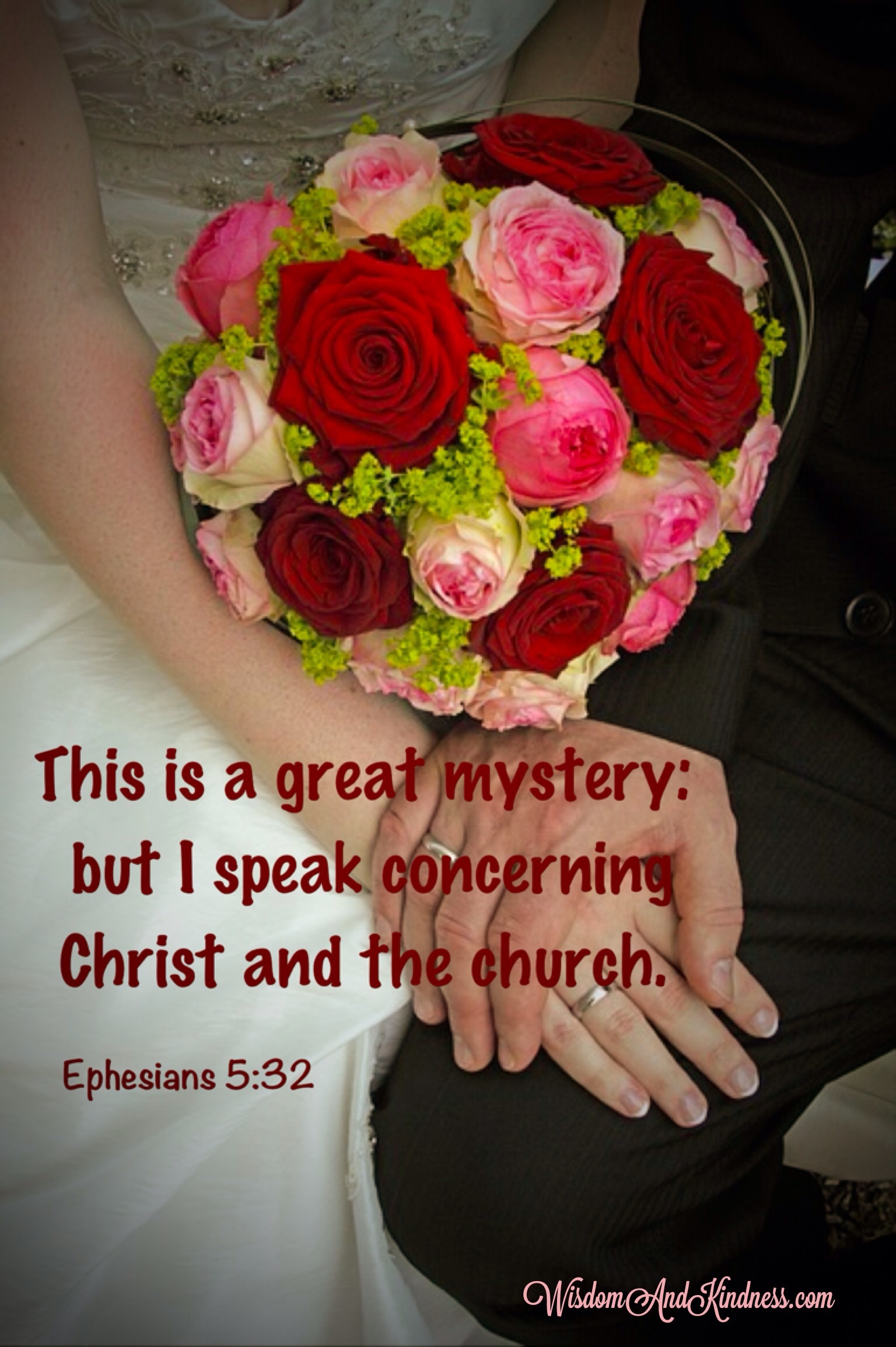
One important observation that should be made by the one that believes and loves God’s Word is that this picture of marriage is found both at Creation in Genesis (Genesis 2:18-25) and in the closing chapters and verses of Revelation (Revelation 21:2,9; 22:17).  In the very beginning of the Bible, we find God creating a man and his bride.  At the very end of the Bible, we find the God-man, Christ Jesus, coming for His bride.  Perhaps we would not have the spiritual eyes to link the two truths, but the Apostle Paul sheds great light upon these truths in Ephesians 5.  As the Apostle was exhorting and instructing the believers at Ephesus in very practical ways that husbands and wives should treat one another, he uses Jesus Christ and the church as the example.  In his explanation of the proper relationship between a husband and wife, he says:  This is a great mystery:  but I speak concerning Christ and the church (Ephesians 5:32).  A mystery was that which could only be made known by divine revelation.  It was a truth that was hidden or covered until God Himself revealed it – at His appointed time.  The word mystery can be understood in the context of Colossians 1:26: Even the mystery which hath been hid from ages and from generations, but now is made manifest to His saints.  In the same way, the Apostle Paul says that this mystery of marriage concerns Christ and the church.  As Christians, therefore, we should humble ourselves before the Lord asking that He help us understand this mystery which He has revealed in His Word.

God has chosen to demonstrate, in a visible way, the spiritual truth of Christ and the church.  And that visible demonstration is to be seen in marriage – in the relationship between a husband and wife.  For the Christian, this truth has tremendous implication as to how we are to respond to our own husband or to our own wife.  How often do we consider that our day-to-day functioning as husband and wife can bring much glory to the Lord, or actually cause His name to be blasphemed (Titus 2:5)? Let us consider a few parallels between God’s institution of marriage and Christ and the church.

–  Adam was formed first, then Eve (Genesis 2:7).  Christ was existent long before the church became His bride (Colossians 1:16-17).

–  God caused a deep sleep to fall upon Adam, so that his bride could be taken from his side (Genesis 2:21).  It was through the death of Christ that the church was brought forth.  He was pierced in His side (John 19:34).

–  Adam called Eve bone of his bone and flesh of his flesh (Genesis 2:23).  Regarding Christ, the church is called members of His body, of His flesh, and of His bones (Ephesians 5:30).

–  Just as God joined Adam and his wife into one flesh (Matthew 19:4-6), Christ and the church are joined into one flesh, as the believer becomes a member of His body (Ephesians 5:30).

–  Interestingly, the Scripture teaches that Adam was not deceived, but the woman was deceived (1 Timothy 2:14).  Similarly, Christ was not deceived, as He came and paid the sin debt for his bride (John 18:11).

–  Traditionally, a bride was bought with a dowry.  Christ bought and paid for His bride. For ye are bought with a price (1 Corinthians 6:20).

–  God brought the woman and gave her to Adam (Genesis 2:22).  A bride was traditionally given in marriage by her Father.  It is the Father that gives the church to Christ (John 18:9).

–  A bride traditionally gave up her identity and took the name and identity of her husband.  The Scripture teaches:  Male and female created He them; and blessed them, and called their name Adam, in the day when they were created (Genesis 5:2).  Likewise, the Christian should leave the old life behind and take upon the identity and name of her new Husband.  Listen to this beautiful analogy in the Psalms:  Hearken, O daughter, and consider, and incline thine ear; forget also thine own people, and thy father’s house; So shall the king greatly desire thy beauty: for he is thy Lord; and worship thou him (Psalm 45:10-11).

–  In marriage, God joins the two together (Mark 10:8-9).  In salvation, the believer is joined to the Lord (1 Corinthians 6:17).

–  As the marriage is consummated, the wife gives herself to the husband, and the husband comes in unto her.  In salvation, the believer gives herself to the Lord, and He, through the Holy Spirit, comes in unto her (Romans 8:9) .

–  The intimacy between a husband and wife should continue throughout their lives.  The intimate relationship between a believer and the Lord will continue throughout eternity (Revelation 21:2,3).

–  The husband and wife are to forsake all others and be faithful unto death (Romans 7:2).  The Lord has said that He will never leave us nor forsake us (Hebrews 13:5).  The church is to forsake all else and be faithful unto death (Revelation 2:10).

–  The husband is to be the head, and the wife is to be a member of his body (Ephesians 5:23, 31).  Christ is the Head of the church, and the church, collectively, are members of His body (Ephesians 5:30).

–  The husband is to love the wife (Ephesians 5:25).  The wife is to respect her husband and arrange herself under his authority (Ephesians 5:24,33).  Christ loves the church with a perfect love, and the church is to respect and reverence Him and to arrange herself under His authority (Ephesians 5:24-25) For this cause shall a man leave his father and mother, and shall be joined unto his wife, and they two shall be one flesh.  This is a great mystery: but I speak concerning Christ and the church.  Nevertheless let every one of you in particular so love his wife even as himself; and the wife see that she reverence her husband.

Ephesians 5:31-33

We have lost much of the beauty of marriage.  It is a relationship as no other.  It is the relationship that God Himself has chosen to reveal the mystery of Christ and the church.  As those around us view our marriage, they should see a picture of Christ and His church – because God has chosen that relationship to reveal His truth.  May the Lord renew our minds and hearts that we may see our marriage as He sees it.  Then, may we guard carefully the beauty and the mystery of marriage.

For of Him, and through Him, and to Him are all things:

to whom be glory forever.

Amen
Romans 11:36

Being Modest in an Immodest World

Modest apparel

Many years ago I stood, looking into my closet, trying to determine what I should wear. I seemed double-minded in my thoughts.  The world and my own desire to be attractive pulled me in one direction.  The truth of the Word of God and the Spirit within me pulled me in another. It was then that I began to study the Scriptures looking for truth to guide my daily choices.  Yes, daily I had to choose what I would wear.  Some days I chose well.  Other days I leaned to the world and to my own desires.  Which way would I ultimately go?  Following are lessons that I learned along the way which helped to establish:

A Chaste Appearance

Did you know that the Word of God teaches that everything that we say and everything that we do comes from the heart (Luke 6:45, Mark 7:21­-23)?  You can learn much about someone’s heart by listening to the words that she speaks.  You can tell much about someone’s heart by watching the deeds that she does.  And you can tell much about someone’s heart by observing the way that she dresses.

As a Christian woman, your testimony about the Lord can be enhanced by the way that you dress or it can actually be destroyed.  Outward dress alone is not the essence of your spiritual life, but your spiritual life will directly affect your outward dress.  That which is in the heart will surface in the way that you dress.

The fallen human heart is, in truth, always and only about itself.  It seeks its way – that  which pleases itself and brings attention to itself.  The Bible teaches that the lust of the flesh, and the lust of the eyes, and the pride of life, is not of the Father, but is of the world (1 John 2:16).  It is so easy to fall into each of these areas of sin regarding our outward appearance.

The first area of sin from which we must flee deals with the lust of the flesh.  When we fail to safeguard this area of our lives, we cause many men and brothers in Christ to stumble because of our actions.  If we dress in a sensual way, we not only provoke them to sin, but we are actually a participant of that very sin with them.  May God help us understand.  A woman usually desires to be attractive, but if the attraction she seeks is a sensual one, she falls far short of God’s desire for her.  Even if this woman says with words that she is not desiring to have a sensual appearance, if she is revealing her body and shape in any way, she does in fact have a sensual appearance – that which appeals to the senses. Modesty always seeks to cover, not to reveal.

The second area of sin from which we must flee is the lust of the eyes.  Within the fallen human heart is the sin of covetousness.  The fallen heart lusts after that which it sees and after that which another may possess.  In our manner of dress, we can cause a brother or sister in Christ to stumble if we dress in an extravagant or showy way.  We may be the catalyst that causes covetousness to arise within the heart and the lust of the eyes to predominate.  Again, we need the Lord to open our understanding to these truths.  If the desire of our heart is to love one another, to strengthen one another, to build and encourage one another, we will willingly place limitations upon ourselves for the good of others.

And finally, we must flee from the pride of life within our heart.  This pride may be associated with our position, our possessions, or our physical attributes.  We may dress in a way that draws the attention of others to those things.

May we learn to consistently flee those things. But there is also another subtle sin that can creep into the heart of the Christian woman.  A prideful heart that says, “Look at how godly I am,” is perhaps the most wicked heart of all.  Jesus pronounced woes upon the Pharisees that made clean the outside of the cup and the platter, but within were full of extortion and excess.  He condemned the manner in which they were like whited sepulchers, which indeed appeared beautiful outwardly, but within were full of dead men’s bones and all uncleanness.  They were rebuked because outwardly they appeared righteous unto men, but within they were full of hypocrisy and iniquity.  His word to them was not that they disregard the outside, but that they cleanse that which was within, that the outside might be clean also (Matthew 23:25-28).  You see, it is so easy to attempt to get the outside right so that people may look at us and admire our “godly appearance” without us ever having a concern for our hearts.  However, our Lord says that if the heart is right, the outside will be right also.  When the motive of the heart is to love our God and to love others, right dress will follow.

We have looked at some of the negative aspects of dress – those things which we should not do, but how uplifting it will be to look at the positive aspects of dress – those things which the Word of God instructs.

Without an excessive amount of attention given to ourselves, the Scripture instructs women to maintain a certain appearance.  We will examine certain words and thoughts, directly from the Bible, to discover the deep underlying truths about a woman’s appearance.  Simple practical suggestions will also be included.  It is our prayer that the eyes of your understanding may be enlightened as we examine these six truths.

In like manner also, that women adorn themselves in modest apparel, with shamefacedness and sobriety; not with braided hair, or gold, or pearls, or costly array; but (which becometh women professing godliness) with good works.  

1 Timothy 2:9-10

Orderly – In 1 Timothy 2: 9-10, the word translated as modest is kosmios and means:  orderly, well-arranged, decent. This would indicate that there should be a certain order to our appearance.  We should display neither a disorderly nor an unkempt appearance.  Our God is a God of order, and all things about our lives should reflect His order.  It is interesting to note the lovely appearance of the virtuous woman of Proverbs 31.

She is not afraid of the snow for her household:

for all her household are clothed with scarlet.

She maketh herself coverings of tapestry; her clothing is silk and purple.

Proverbs 31:21-22

Modesty – The next word at which we will look is shamefacedness.  The word means:  modesty.  Perhaps the most literal translation is:  not known.  Though we are to be fully known to our husbands, we should seek to be not known to all others.  Practically, this would affect many choices in apparel.  Our clothing should be loose fitting, seeking to conceal our shapes, rather than seeking to reveal them.  Necklines, dress lengths, and the fit of the bodice of clothing should all conform to this guideline, seeking that our shapes be not known.  A jacket, sweater, or blazer worn over a dress will also add to a modest appearance.  And finally, should any of your long dresses have slits, they should be altered so that the slit does not reveal much of the leg.  The eye is drawn to a slit in a dress, especially as you walk or sit.  That simple slit may be suggestive of sinful thoughts to another.  Remember, modesty seeks to cover, not to reveal.

Soberly – The word sobriety means: with a sound mind.  It entails right thinking to the point that it affects behavior.  We should think so rightly about proper dress that it will affect choices that we make, and hence, clothing that we wear.  Remember that all of our life should have two main goals:  To love the Lord God and to love others (Matthew 22:35-40).  Our dress, therefore, should be pleasing to the Lord and should not cause others to stumble.  Out of a love for the brethren, we should seek to wear things that would neither cause a brother to lust, nor a sister to envy.  Right thinking is of the utmost importance in the things that we choose to wear.

Simplicity Not with braided hair, or gold, or pearls, or costly array.  Each of these things, in extravagance, has a showiness about them – a showiness that would cause attention to be drawn to our self, rather than to our Lord.  We should never dress in an extravagant way.  If we seek to dress with simplicity, it will affect each those things referred to in this verse – our hairstyle, our jewelry, and the clothing that we wear.  Modesty and simplicity – what wonderful companions!

Femininity – Deuteronomy 22:5 states:  The woman shall not wear that which pertaineth unto a man, neither shall a man put on a woman’s garment:  for all that do so are an abomination unto the LORD thy God.  Therefore, we should seek to have a distinctly feminine appearance.  Choose clothing, hairstyles, etc. that are distinctly feminine.  For a woman to possess a feminine appearance is pleasing to the Lord.  He designed her to be distinctly feminine.  Choose your clothing in light of this truth.

Purity – In Titus 2:5 young women are instructed to be chaste.  This word has the meaning of:  purity.  Seek to have a pure appearance in all ways.  Remember it is the Lord that you represent, and He is holy and pure.  We will see Him one day and will be like Him in that day.  The Scripture says:  Every man that hath this hope in Him purifieth himself, even as He is pure (1 John 3:3).

Study these words – study these truths!  Write these words down, and bring them with you as you shop.  Ask yourself questions to see if that which you purchase is pleasing to the Lord.  Spend a few hours in your closet, before the Lord, in an honest evaluation of your wardrobe.  You will probably find that you need to eliminate some things.  Recalling these words will also help you decide what to wear on a daily basis.  Take time to evaluate all facets of your appearance:  your clothing, your hairstyle, your make-up, and your jewelry.  An honest evaluation will produce a godly appearance.  Ask yourself:

  1. Is it orderly?
  2. Is it modest?
  3. Am I demonstrating right thinking by wearing this?
  4. Does it exhibit simplicity?
  5. Is it feminine?
  6. Does it enhance a pure appearance?

If you can answer yes to all of these questions, your outward appearance should be scriptural.

There are, however, two additional factors of far greater importance than outward dress in the life of a godly woman.  Take time to look up the following verses and to meditate upon them.  They will be a blessing to your heart.

A godly woman must possess the right heart attitude (see 1 Peter 3:3-5).  Always remember that God looks upon the heart. Spend much time allowing Him to adorn your heart.  It will be pleasing to Him – and interestingly, it will be a blessing to those around you.

A godly woman must be adorned with good  works (see 1 Timothy 2:9-10).  The most important matter of our life is not about our self.  It is about others.  Rather than all of our time and attention being given to our outward appearance, it should be given to ministering to others – to our husbands, to our children, to those in need, and to those whom the Lord would have us serve.

In conclusion, your appearance should reflect your Lord.  It will also reflect your husband and make a statement about what kind of wife he has.  Your appearance should reveal humility, submission, modesty, and godliness without being unkempt and disorderly.  The motive of the heart is the key.  Are you seeking to reflect your Lord in your appearance, or are you seeking to draw attention to yourself?  Are you pursuing godliness, or are you pursuing the things of the world?

… whatsoever ye do, do all to the glory of God.

1 Corinthians 10:31

Dead or Alive, or Both?

I live yet not I

I beseech you therefore, brethren, by the mercies of God that ye present your bodies a living sacrifice, holy, acceptable unto God, which is your reasonable service. Romans 12:1

What insights can we glean from the Word of God about being a living sacrifice? Perhaps one of the first things we find is that this sacrifice is alive! It is not a dead sacrifice. It is a life full of the Spirit of God – a life full of the Lord Jesus Christ Himself. Yes, it is a living sacrifice and never a dead work.

Secondly, we learn much by meditating on the word sacrifice. Biblical sacrifices always required the death of the one being sacrificed. It may seem conflicting to think of a living sacrifice being alive and dead at the same time, but listen to the words of the Apostle Paul: I am crucified with Christ: nevertheless I live: yet not I, but Christ liveth in me: and the life which I now live in the flesh I live by the faith of the Son of God, who loved me, and gave Himself for me (Galatians 2:20).  Yes, there is death and life at the same time. The death of ourselves – we have been crucified with Christ – and the life  of Christ in me – a living sacrifice.

Now the real question is: Do we present our bodies to live in this way? Do we deny ourselves? Do we say “Not my will, but Thine be done”?  Do we seek to be alive in Christ, living that abundant life that He has promised? If so, do we realize that we are only giving back to God that which is actually His? The Bible teaches that we are not our own. We have been bought with a price (1 Corinthians 6:19-20). And that price was the precious blood of our Lord Jesus Christ (1 Peter 1:18-19). If we are Christians, we are not our own. We have actually been bought by the Lord, and He may use our lives in any way that He desires.  How blessed and peaceful it is just to walk in agreement with Him!

We may also notice from the Romans 12 verse that being a living sacrifice is our reasonable service. It just makes sense that we would serve the One who has saved and delivered us. Why then, would the Apostle Paul have to beg these Christians to present themselves as a living sacrifice in service to the Lord?

Luke 17:11-19 tells the story of Jesus cleansing ten lepers, but only one returned to Jesus to thank Him.  What a sad thought – that great miracle was performed for all ten, but nine of them went on their way, never returning to thank Him. How often we are just like those nine! May God forgive us!

Look at the sacrifice that we are to bring to the Lord: By Him therefore, let us offer the sacrifice of praise to God continually, that is, the fruit of our lips giving thanks to His name (Hebrews13:15).  As with those lepers, all that we can bring to Him is praise and the giving of thanks.  We must turn from our own way, return to Him, and give back to Him that which He so richly deserves!

Let’s give some time to one further thought about a living sacrifice. Do you know that there is really nothing else that we can bring to God? He has done all that is necessary, through the death and resurrection of the Lord Jesus Christ, for each of us to be brought into a living relationship with Him. There is nothing that we can do, and certainly there is nothing that we can bring Him. He owns it all. All belongs to Him.

Hear the questioning rebuke of Paul: What do you have that you did not receive? Now if you did receive it, why do you glory, as if you had not received it? (1 Corinthians 4:7)

Perhaps a living sacrifice can be understood as described by the heart of David as he had painstakingly gathered all of the gold, silver, brass, stones, wood, iron, works of the artificers, and much more for the building of the temple. Knowing that God had chosen Solomon for the work, the people rejoiced as they gave all of these and more offerings for the work of the Lord (1 Chronicles 29). After much outpouring of praise (v. 10-13), David asks this question: But who am I, and what is my people, that we should be able to offer so willingly after this sort? For all things come of Thee, and of Thine own have we given Thee (v. 14). He continues: O Lord our God, all this store that we have prepared to build Thee a house for Thine holy name cometh of Thine hand, and is all Thine own (v. 16). Truly it is all His own, and we can only give back to Him of His own!

Take time to meditate on and pray about all that God has given to you. Think deeply on the blessings of salvation, the blessings of your family, the blessings of health, the blessings of gifts and talents, and so much more! How would God have you bring each of those things to Him, giving them back to Him, accompanied with praise and the giving of thanks? What does it mean, in your life, to actually present your body to God as a living sacrifice? It is truly the fullest life that one can live!

I beseech you therefore, brethren, by the mercies of God that ye present your bodies a living sacrifice, holy, acceptable unto God, which is your reasonable service. Romans 12:1

Living for the Great Things

But the Greatest of These

Every human being who has ever lived has had the same number of hours in each day.  From the most famous president or king to the least-known person of all time, each has had the same amount of time given for each day.  Our Lord Himself, as He entered time and walked upon the earth, had twenty-four hours in each day.  Do you know how our Lord spent His time?  Jesus said that He always did those things that pleased the Father (John 8:29).  What are the things that please the Father?  What are the things that He considers “great” things?  How should we spend each day that we have been given upon this earth?

When asked which was the greatest commandment in the law, Jesus answered: Thou shalt love the Lord thy God with all thy heart, and with all thy soul, and with all thy mind.  This is the first and great commandment.  And the second is like unto it, thou shalt love thy neighbor as thyself.  On these two commandments hang all the law and prophets (Matthew 22:37-40).

Do you want to live for the greatest things?  The greatest things in this life will never be the grandiose, showy things admired by men.  The greatest things that one could ever hope to attain to are loving God and loving others with the love of God.  This love will require all of your heart, all of your life, and all of your time.

The Bible speaks of important and great things, yet none is greater than love.  And now abideth faith, hope, charity (love), these three; but the greatest of these is love (1 Corinthians 13:13).

How great is faith?  Certainly, it is a great thing.  The Scriptures teach that without faith it is impossible to please God (Hebrews 11:6), and that by grace are ye saved, through faith (Ephesians 2:8).  Most surely, faith is a great thing, but the greatest of these is love.

What a wonderful thing hope is!  Hope is that confident, sure expectation that God will do what He has said – and that confident assurance that He will come again.  Truly peace and rest come from hope, but the greatest of these is love.

Why is love the greatest of all things?  Perhaps it is because it brings much glory to our Lord, for it reflects Him as He is.  But God, who is rich in mercy, for His great love wherewith He loved us, even when we were dead in sins, hath quickened us together with Christ, (by grace are ye saved;) And hath raised us up together, and made us sit together in heavenly places in Christ Jesus (Ephesians 2:4-6).

Look closely:  it was because of His great love for us, even knowing how sinful that we were, that He died for us.  You see, He did what was for our true good, no matter the cost.  And indeed, the cost was great – it cost Him His only Son.  In this act, we see such demonstration of His love (Romans 5:8, 1 John 4:9-11).

Did you know that on the very evening that Jesus was going to be taken and eventually be crucified, He called His disciples together to emphasize some things to them?  Listen to the words of Jesus:  A new commandment I give unto you, That ye love one another; as I have loved you, that ye also love one another (John 13:34).  This is my commandment, That ye love one another, as I have loved you.  Greater love hath no man than this, that a man lay down his life for his friends (John 15:12-13).  These things I command you, that ye love one another (John 15:17).  And the final words of the final prayer of Jesus to the Father:  And I have declared unto them Thy name, and will declare it:  that the love wherewith Thou has loved Me may be in them, and I in them (John 17:26).  Yes, the greatest of these is love!

Listen as the Apostle Paul teaches why love is the greatest of all things: … For he that loveth another hath fulfilled the law.  For this, “Thou shalt not commit adultery, Thou shalt not kill, Thou shalt not steal, Thou shalt not bear false witness, Thou shalt not covet”; and if there be any other commandment, it is briefly comprehended in this saying, namely, Thou shalt love thy neighbor as thyself.  Love worketh no ill to his neighbor:  therefore love is the fulfilling of the law (Romans 13:8-10).  The Apostle Paul speaks this same truth as he writes to the Galatians:  For all the law is fulfilled in one word, even in this; Thou shalt love thy neighbor as thyself (Galatians 5:14).  Yes, the greatest of these is love!

Do you want to live for the great things?  The greatest thing you can do for anyone is to love him or her as God has loved you.  No matter the depth of their sin, no matter the cost to you, no matter the response, you do what is for their truest good.  That is how God has loved you!

What is the greatest thing that you can do for your husband?  Love him, as God has loved you! What is the greatest thing that you can do for your children?  Love them, as God has loved you! What is the greatest thing that you can do for whoever comes to your mind?  Love them, as God has loved you! The Apostle John, who was taught by Jesus Himself in those final hours, declares:  He that loveth not knoweth not God; for God is love (1 John 4:8).  And speaking of the sacrificial love of the Father in sending His only Son to bear our sins for forgiveness, John says:  Beloved, if God so loved us, we ought also to love one another (1 John 4:11).

Yes, the greatest of these is love!  Die to yourself, and live for the great things.  You only have twenty-four hours in each day.  And living for the great things is the most fulfilling life that you can find!

On that fateful night before Jesus was bound and taken away, He said to His disciples:  These things have I spoken unto you, that my joy might remain in you, and that your joy might be full (John 15:11).

Lord, renew our minds.  Remind us that we need not spend our lives consumed with ourselves.  You are a perfect Heavenly Father, and You care perfectly for Your children.  You will care for our needs.  Help us seek the great things – the truly great things.  And thank You, Lord,  for the great love wherewith You loved us. 

Submit or Resist?

Authority is of God

In our world today we see so little of true submission. We live in a day and time where the prevailing thought is both individualistic and assertive. We have been steeped in the thought of, “Do your own thing.” The world boldly proclaims, “Look out for number one!” In the “me” society in which we live, we see so many who spend all of their time, energy, and money seeking only after things for themselves, exalting themselves, asserting themselves, and demanding their “rights.” And though we may see the error of their way, we, too, must be very careful that we are not drawn into that worldly thought.

Biblical submission stands opposed to all that the world proclaims. Biblical submission understands that it is God who has ordained all authority. For there is no power (authority) but of God. Authority is ordained of God. Therefore, whoever resists authority, resists the ordinance of God (Romans 13:1-2). Biblical submission declares that because the Lord has set in place authority, we must submit ourselves to that authority if we are to be in submission to our Lord.

Let us remind ourselves of the meaning of the word submission. Sometimes translated as submit yourselves, sometimes translated as subject yourselves, and sometimes translated as obedience, the Biblical word for submission is hupotasso in the Greek. The literal translation means: to arrange oneself under; to place oneself under in an orderly fashion; to appoint oneself under; to ordain oneself under. The word is from the root word tasso, meaning to appoint; to ordain; to arrange. The prefix hupo has the meaning under, hence the combined meaning of hupotasso is: to arrange under or to appoint under.

Now let’s look at the Greek word for resist (antitasso). Interestingly, this word is formed from the same root as hupotasso. But notice carefully the prefix – anti, which means against. Therefore, the meaning of resist is: to arrange oneself against. Can you see the contrast between the two – to arrange under (hupotasso) and to arrange against (antitasso)?

Now let’s refer to the Scriptures: For there is no power but of God: the powers that be are ordained of God. Whosoever therefore resisteth the power, resisteth the ordinance of God (Romans 13:1-2).

Now for a final thought – Do not miss the fullness of the truth of the Word of God. If one resists the authority that God has established, she resists the ordinance of God. The word ordinance is diatage in the Greek, and is the noun form of the word diatasso. Did you catch the root of the word? The prefix dia means: through, thoroughly, or completely. This prefix is combined with the root tasso, again meaning to ordain, to arrange, to appoint. God has thoroughly and completely arranged the authority that is to be over each individual. When someone resists that authority, she resists God’s order, God’s arrangement, God’s appointment.

If indeed there is no authority but of God, and all authority is ordained of God, when we resist that authority, we resist God Himself. What a hopeless state in which to be!

We find this Biblical truth: Yea, all of you be subject (hupotasso) one to another, and be clothed with humility: for God resisteth the proud, and giveth grace to the humble (1 Peter 5:5). Yes, God resisteth (antitasso) the proud. God’s Word says that He arranges Himself against the proud!

But how wonderfully we find this truth: He gives grace to the humble.

May we not find ourselves resisting the Lord Himself.

May we humble ourselves and arrange ourselves under the authority which God has ordained over us, for it is there where we find the preciousness of His grace!

Take time to reflect upon these truths and these questions:

Let every soul be subject unto the higher powers … (Romans 13:1). Will you submit or will you resist? Will you arrange yourself under or will you arrange yourself against?

Likewise, ye younger, submit yourselves unto the elder … (1 Peter 5:5). Will you submit or will you resist? Will you arrange yourself under or will you arrange yourself against?

Servants … be subject to your masters … (1 Peter 2:18). Will you submit or will you resist? Will you arrange yourself under or will you arrange yourself against?

Wives, submit yourselves unto your own husbands, as unto the Lord (Ephesians 5:22). Will you submit or will you resist? Will you arrange yourself under or will you arrange yourself against?

There are only two responses to the authority that God has ordained. One will either submit or she will resist. She will either arrange herself under that authority or she will arrange herself against God.

Lord, help us seek to do those things that are pleasing to You!

Word for the Day – Faith

FaithI have been reflecting for the past couple of weeks on the word faith.  I can recall, as a young Christian, being plagued with many doubts about truths in the Scripture.  I vividly remember softly appealing to The Lord to increase my faith. I am sure that I didn’t really understand what I had prayed.  But The Lord put me on a path to do exactly that – to increase my faith.  

Shortly after that simple, but heartfelt, prayer, The Lord placed me in a Bible study. I went into the study keenly aware that this study would be a part of the answer to my request to increase my faith.  Interestingly, I met a young wife and mom who openly talked about her faith.  Almost everything she said she expressed as “believing for this” and “believing for that”.  It seemed as if most of the things that she was believing for were physical things – material things. She had her sights set on a piece of property that she wanted, and she was “believing” for it.  She already had the house plans that she was “believing” for as well.

Although I was such a young Christian, something just didn’t seem right. But I did not have enough of an understanding to sort things out.  So I just wondered about it, and continued on in the Bible study.  God was growing me so much through the Bible study and I just couldn’t get enough of it.  I looked so forward to the time that I had set aside each day to study.  I had a young child and each day when he took his afternoon nap, I studied.

One day as I was in the book of Romans, God opened up a passage of Scripture to me that forever changed my life.  The implications of this passage continues with me till this day.  We were studying the life of Abraham, known as the Father of Faith, and here is what I read: He staggered not at the promise of God through unbelief; but was strong in faith, giving glory to God: and being fully persuaded that, what He had promised, He was able to perform.  Romans 4:20-21

What I saw opened my understanding to such a greater place.  Abraham was described as being strong in faith, but what he was trusting was not in what he wanted.  He was trusting in what God had said!

I pondered those verses over and over.  Faith was not about me!  It was not about me deciding what I wanted from God.  It was about me learning what God has said, and being fully assured and confident that He has done what He said He would do, that He is doing as He said He will do, and that He will do in the future what He has said that He will do.  No matter what the circumstances around me may look like, I must trust what God has said! Remember Abraham considered not his own body now dead, when he was about a hundred years old, neither yet the deadness of Sarah’s womb. In spite of the circumstances, he trusted what God had said! That is what strong faith looks like!

I have learned that circumstances will betray you.  Circumstances will cause you to doubt.  Circumstances will cause you to forget what God has said. Circumstances will cause you to give up hope! I understand a little bit more of what the Bible says that, for the Christian, we walk by faith, not by sight!

Then my understanding of faith grew yet again.  We all well know the verse: Faith cometh by hearing, and hearing by the Word of God. Romans 10:17. If faith is being fully persuaded that God would do as He has said, I now saw the absolute necessity of knowing what He has said.  I could not be fully persuaded of something that I did not know.  His Word became of supreme importance.  It really didn’t matter what I thought or what someone else thought or said,  the only important thing was what has God said.  Then, I needed to be fully assured of that truth, no matter the circumstances and no matter the arguments.

I was back in Romans again, and decided to read the book in its entirety.  I smile now at the naivety of my young Christian life.  The depths of doctrine! But off I went reading throughout! When I got to the end of the book I found a phrase that that I had also found in Chapter 1: the obedience of faith. Actually, I was a little bit confused.  If faith was simply trusting what God had said, what did obedience have to do with it?  I asked a couple of people my question, but they were about as “knowledgeable” as me, so I didn’t get my question answered.

But I continued to study.  I ended up in the well-known passage called the “Hall of Faith” of Hebrews 11. It was here that I saw the obedience of faith exemplified. And again my understanding grew.

What I had learned so far:  To live by faith 1) I must have heard what God has said and 2) I must believe it, being fully persuaded that God will keep His Word

What I was about to learn:  Obedience would be the proof that I had actually heard God and believed Him.

I reflected on several of those saints of old named in Hebrews 11.

By faith Abel:  Abel had heard God, believed Him, and did what God had told him to do.

By faith Noah:  Noah had heard God, believed Him, and did what God had told him to do.

By faith Abraham: Abraham had heard God, believed Him, and did what God told him to do.

By faith Moses:  Moses had heard God, believed Him, and did what God told him to do.

The list goes on.  But what I saw was that faith and obedience are inseparably linked.  When a person has heard God, and believed (trusted) Him, it will be seen as that person does whatever God has spoken to him.

So let’s get very practical:

Have I heard from God about the Creation?

Have I heard from God about His Son?

Have I heard from God about my sin?

Have I heard from God about how I am to treat others?

Have I heard from God about the necessity of forgiveness?

Have I heard from God about my words?

Have I heard from God about being a loving and helpful wife to my own husband?

Have I heard from God about how to raise the children that He has given me?

The questions are many, but I would encourage you to write a list of the things that God has very clearly spoken to you and taught you. Then trust Him with all of your heart to bring them to pass. Next, change the things in your life that He shows you that need to change to get in line with His will and His Word!  I plan to do the same. Remember, James 1:22 says that if we are hearers only, we deceive our own selves.

Lord, you have spoken to us about so many things.  Help us be strong in faith, in spite of the circumstances and in spite of our own weaknesses.

Humbly, I pray once again, Lord, increase my faith!

Authority Speaks – Are You Listenting?

Let the Word dwell in you richly

Thus did Moses:  according to all that the Lord commanded him, so did he.

Exodus 40:16

 Who is the person to whom God has regard? … but to this man will I look, even to him that is poor and of a contrite spirit, and trembleth at My word (Isaiah 66:2).  The person to whom God has regard is the one who is humble in heart, who exalts the Lord, and who reverences His Word.  All through the Scriptures, wherever we see those considered to be mighty men or women of God, we see humble hearts, we see honoring of the Lord God, and we see such an esteem for His Word that humble obedience to that Word is demonstrated in their lives.  True humility produces obedience, and true humility reverences authority.

By design, authority speaks.  Speaking is the means whereby the one in authority communicates his desires, and thereby his instructions to bring about those desires.  This speaking may be in written form or in verbal form, but speaking is always found where authority is found.  You may see this practically demonstrated in any area where authority is present.  As employees begin a project at work, how will they know that which is expected of them?  At some point in time, the boss will speak, directing how he expects that work to be done.  Picture a classroom of students.  As they enter the classroom and take their seats, what would happen if the authority in that classroom did not speak?  It is through speaking that the teacher communicates to those students that which is expected of them.  We certainly know of the same truth as evidenced by parents and their children.  Authority is meant to speak.  And, of course, the highest and ultimate example of this truth is how the Lord God speaks.  He is the Creator of Heaven and earth, and as the Ultimate Authority, He speaks.  In actuality, He is the only One who has given authority to any other.

The question for us should then be:  If authority speaks, are we listening?  Do we even know how to listen?  For the Christian, we must fully realize that the Lord God is the Supreme Authority and He has spoken.  He has spoken through His Word.  How many times in the Old Testament do we find these words:  thus saith the Lord?  And the Word of God is clear:  God, who at sundry times and in divers manners spake in time past unto the fathers by the prophets, hath in these last days spoken unto us by His Son … (Hebrews 1:1-2).  God has, unquestionably, spoken.  How, then, can we hear?

First, the condition of our heart is of extreme importance.  Did you notice in the Isaiah passage that it is a person that is poor and of a contrite heart to whom the Lord looks?  And secondly, it is a person that trembles at His Word – one who highly reverences His Word.  When, with a humble heart, one listens to the Word of God as the Word of God, intent on doing that which He speaks, then the heart is in the position to hear.

How does God speak?  You may say that He speaks through Creation.  Yes, He does, but the Creation will be a picture and reminder of Who He is and what He has said!  The Scripture is replete with examples from the Creation that teach spiritual truths.  Consider the fowls of the air … I am the vine, ye are the branches … Behold, a sower went forth to sow seeds … Go to the ant, you sluggard … The grass withereth, and the flower thereof falleth away: but the Word of the Lord endureth forever.  The list goes on and on.  Certainly God speaks through His Creation.

You may say that He speaks through music.  Yes, He does speak through songs that are a reminder of the truth of His Word.  Let the word of Christ dwell in you richly in all wisdom; teaching and admonishing one another in psalms and hymns and spiritual songs, singing with grace in your hearts to the Lord (Colossians 3:16).

You may say that He speaks through others.  Yes, He does, but it will only be as they encourage, exhort, and speak the truth in love, a reminder of the Word of God (Ephesians 4:15).

You may say that He speaks through circumstances.  Although this is a phrase that we hear often, we must be very careful.  Did you know that the word circumstances is not found in the Scriptures?  And, very often, it is when we look at the circumstances that we go astray.  Because of circumstances, Abraham went to Egypt.  Because of circumstances, Sarah suggested Hagar as the solution for a child.  Because of circumstances, Peter denied the Lord.  Again, the list goes on.  We must always look to the truth of the Word of God, no matter the circumstances.  God speaks through His Word.

You may say that God speaks through His Spirit.  Yes, He does!  But never forget that He is called the Spirit of Truth.  He always speaks in full agreement with the Father and the Son.  He always speaks in agreement with the full counsel of the Word of God.  In actuality, He will bring into your remembrance the Word (John 14:26). Yes, authority speaks.  God speaks and has spoken.  In most cases, as we seek the will of God in a situation, we may find our answer by simply asking:  What has God already said?  The problem that we face is not that He has not spoken, but that, in most cases, we have not heeded that which He has already spoken.  Lord, help us with a humble heart to hear and to heed – to be as those who tremble at Your Word.

In a similar way, the Christian wife is to arrange herself under her own husband’s authority.  For the husband is the head of the wife – God has designed it and declared it to be so!  We, then, as wives, must learn to hear our husbands, and to heed that which they speak.  A wife may ignore him, reason against him, argue with him, or defy him.  But the truth is that there is a great need to respect him as the authority that God has lovingly given, and with a humble heart, listen carefully that the wife may do that which her own husband speaks.  And in many situations, we need to ask: What has he already said?

In our Christian lives, when we are hearers only and not doers of the Word of God, we deceive our own selves (James 1:22).  Likewise, as Christian wives, we deceive our own selves when we hear only, but do not do as our husbands speak.  Jesus said:  My sheep hear My voice, and I know them, and they follow Me (John 10:27).  A godly wife will hear, and she will follow!  Authority speaks – are you listening?